
Reeds Solar Farm
Low Carbon is proposing a new solar farm, to be known as Reeds Solar Farm co-located with energy storage, situated on the land north of Alders Road, Capel. The project will have a generating capacity of approximately 10 megawatts (MW), producing enough clean renewable energy to cover the annual electrical consumption of approximately 3,300 homes each year.
Contact us:
Email: info@reedssolarfarm.co.uk.
Call our free information line: 0800 458 9979
Welcome to
Reeds Solar Farm
Low Carbon is bringing forward a new renewable energy project along with the infrastructure needed to export the electricity it generates to the local network operator, UKPN (Eastern).
Reeds Solar Farm, located on land north of Alders Road, Capel will generate approximately 10 megawatts (MW), producing enough clean renewable energy to cover the annual electrical consumption of approximately 3,300 homes each year.
The solar farm, co-located with battery storage will contribute to supporting our transition to a low carbon energy system while securing the energy needs for Great Britain whilst helping to reach our commitment of net zero carbon emissions by 2050.
Reeds Solar Farm is proposed for a period of 40 years, after which the modules would be decommissioned and removed from the land and as many items will be recycled or re-purposed as possible.
Site Location
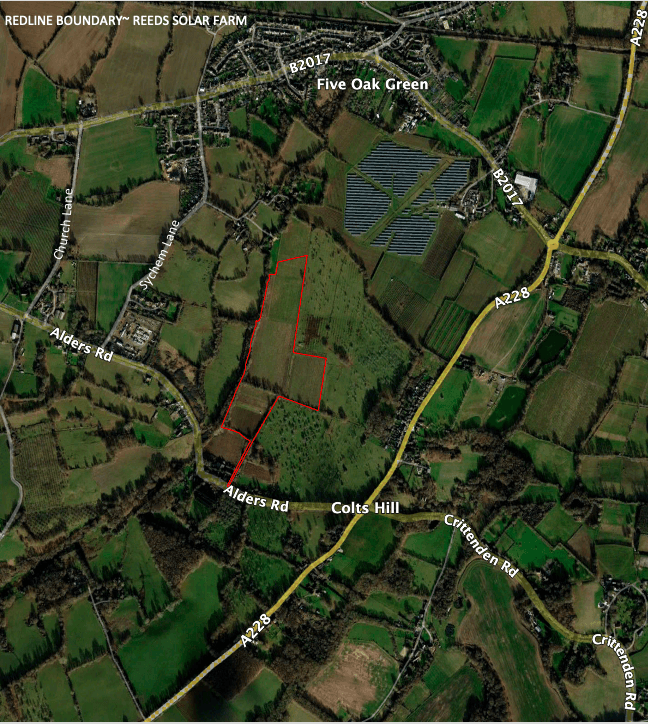
The extent of land available to build Reeds Solar Farm is wholly contained within one site of approximately 11 hectares (27 acres), located on the land north of Alders Road, within Tunbridge Wells Borough.
Construction information
A typical construction period for a solar farm of this scale is around 14-20 weeks. During the construction period, it is estimated that there will be an average of 6-8 HGV trips per day. Whilst this figure is an average, there will often be a higher volume earlier in the construction period and less towards the end. It is proposed that construction working hours would be as follows:08:00 - 18:00 Monday to Friday08:00 - 13:00 Saturday
Access information
At this stage, our proposed construction routes are based on reaching the eastern end of Alders Road via the surrounding A-road network, principally the A228.From the north, the route will use the A26, and from the south the route will be via the A21 and A262.The proposed construction and maintenance route will access the site from an existing farm entrance on Alders Road. We have engaged a Highways Consultant to advise us of the best route. A Construction Traffic Management Plan (CTMP) will be agreed with the Local Highways Authority ahead of any construction.
Point of connection
The electricity generated by the solar panels is proposed to connect into the local distribution network operator, UK Power Networks (UKPN Eastern), via an existing electricity pylon along the western boundary of the site. A transformer substation compound would be built to step up the voltage to be fed into the grid.
Timeline
- July 2022
EIA Screening
- August 2022
Community Consultation
- Early Autumn 2022
Planning application submission to Tunbridge Wells Borough Council
- Winter 2022
Tunbridge Wells Borough Council will consider and determine the application
- Summer 2023/2024
Commencement of Construction (if planning permission is granted)
Additional Information
- A wide range of environmental subjects will be taken into consideration including traffic impacts, landscape and visual impacts and ecology.
- We have submitted a planning application to Tunbridge Wells Borough Council. The full application is now available on the Council’s website with the reference number: 22/03563/FULL. Please click here to view the application.
Benefits
Across our UK-wide portfolio of renewable energy projects, we have championed biodiversity as a critical milestone on the journey towards a low-carbon future.
Across all our solar parks we work with landowners and developers to implement comprehensive land and biodiversity management programmes. Each aligns with the conditions and circumstances unique to its site. Yet while we are pledged to protecting existing flora and fauna, most parks benefit still more from the introduction of extensive new planting and husbandry measures.
As sites mature, ongoing development will realise an increasing diversity of habitats and species: from meadows, hedgerows, wildflowers and woodland to sheep, bees, birds, bats, reptiles and invertebrates.
Biodiversity
It’s important to Low Carbon that the area is improved for nature and, as part of the planning process, we are required to demonstrate that there will be biodiversity gain on the site.
Across all its sites, Low Carbon works to protect and promote sustainable land use and halt biodiversity loss yet seeking to increase biodiversity through the provision of new habitats, such as hedgerow, trees and wildflower meadows to support pollinators such as bees. It does this by understanding the characteristics of each site location and planting species that are native to that area.
Whilst our focus is on using existing woodland, trees and hedgerows to help to screen projects we also typically plant several hundred meters of new hedgerows and/or trees, leading to a net gain in both landscape and habitat.
Planning conditions tend to require both a Construction Environmental Management Plan (CEMP) and a Landscape and Biodiversity Management Plan (LBMP) to be submitted for approval. The former deals with the construction process measures whilst the latter deals with post-construction measures and those throughout the operation of the project.
PROW
As standard practice for Low Carbon, the Public Rights of Way (PRoW) which run through the site will be kept open throughout construction and operation of the solar farm.
In some cases, we may need to have a managed crossing on a footpath during construction for safety reasons, such as a temporarily controlled crossing and/or a banksman.
To screen views on footpaths, we will incorporate buffers of meadow planting either side of the footpath and two-metre-thick hedgerow planting. The objective is to obtain a width of approximately 5-10 metres in total, unless there are specific space restrictions on a particular Public Right of Way, thereby maintaining a feeling of openness.
Beehives
Low Carbon’s solar farms are also home to more than 2 million bees in managed hives, a key action to prevent the extinction of a vital species. The UK has seen a decline in the number of bees in the last few years, however, Low Carbon’s solar sites provide secure environments with readily available food sources. Each of our hives house approximately 60,000 bees and they are tended regularly by trained beekeepers. With the help of our beekeepers, each year we bottle and distribute more than 600 jars of Low Carbon honey to promote the climate change message. We also believe that keeping bees on our sites is setting a positive example within the renewable energy industry.
Sheep
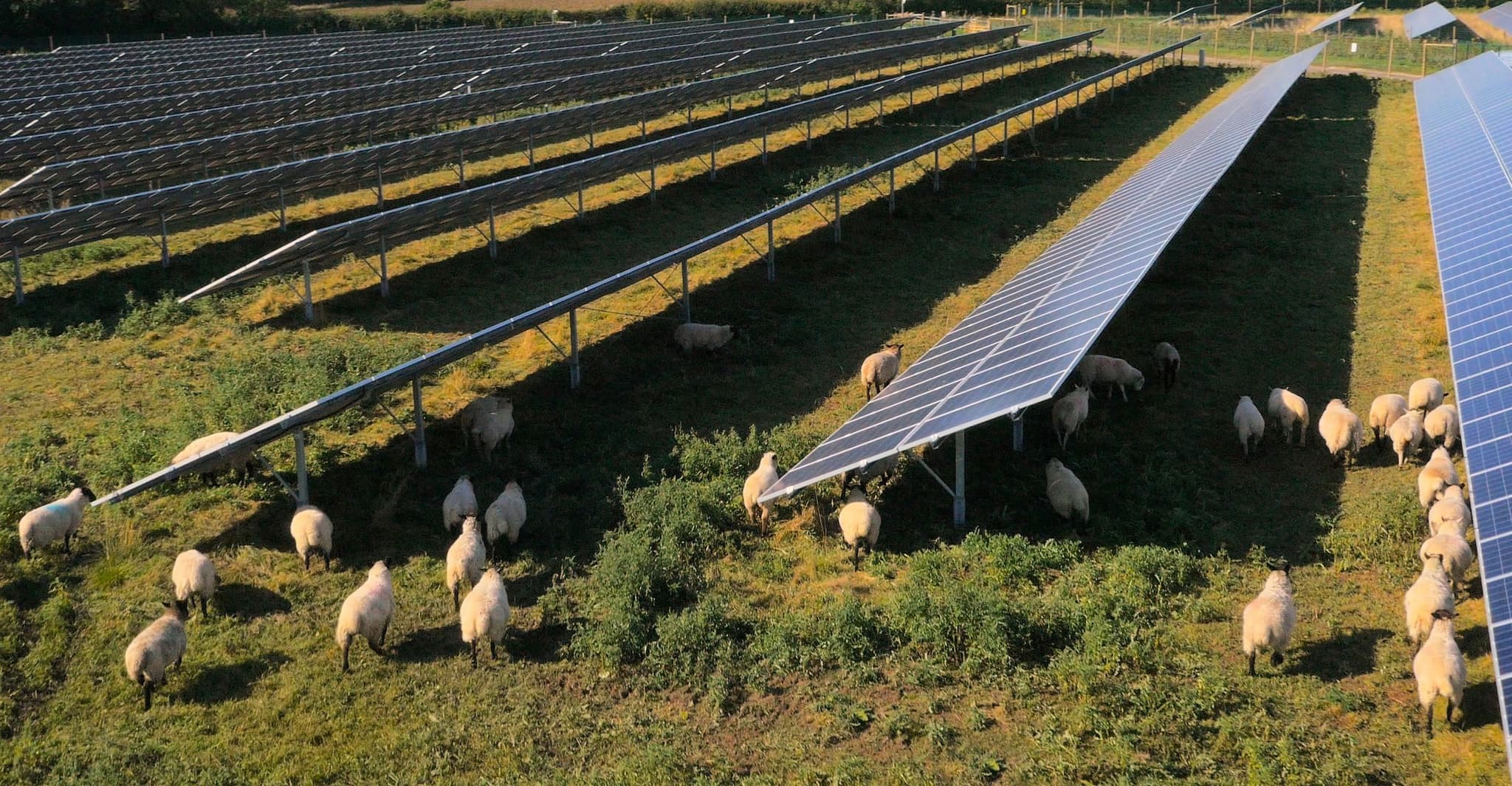
At our solar sites, Low Carbon is committed to working in partnership with local landowners to provide where possible a unique and innovative space for them to graze their sheep amongst the solar panels.
Grazing sheep at our sites has proved to be hugely popular amongst our landlords for several reasons, notably because the sites are secure which means the sheep are safe and the solar modules provide shelter from the winds and shade from the sun and rain.
Planting
Our sites are designed around existing hedgerows and trees. We look
to enhance the site with additional planting of native species of hedgerows, trees, pasture-mix grasses and wildflowers.
FAQs
Low Carbon is the developer of this project and we will use the information gathered at the end of the consultation period to advise on the development of the proposed solar farm.
Here is a selection of questions that have been asked relating to solar farm installations/builds.
Why here?
Low Carbon has carefully identified this site as part of a detailed feasibility process to deliver a large-scale clean energy scheme. Many factors are considered by our specialists when evaluating appropriate sites for development. These include considering the available grid locally as well as various planning and environmental constraints.
Solar offers a low cost, safe and low carbon way of delivering clean power to meet this target as well as reduce the levels of carbon dioxide that are being emitted into the atmosphere by replacing electricity generation from fossil fuels.
Will the solar farm cause any glint and glare?
Solar panels are designed to absorb light and not to reflect it. They pose little risk of glint or glare. Testament to this fact is the installation of solar panels at Gatwick Airport, alongside major roads and beside sports car raceways such as the ‘Top Gear’ test track.
Are there any health risks associated with being in close proximity to solar panels and energy storage facilities?
Solar panel arrays do emit electric and magnetic fields (EMF) in the same extremely low frequency ranges as electrical appliances and wiring found in most houses and buildings.
The average daily background exposure to magnetic fields is estimated to be around one mG (milligauss – the unit used to measure magnetic field strength), but can vary considerably depending on a person’s exposure to EMF from household electrical devices and wiring.
The lowest exposure level that has been potentially associated with a health effect is three mG. Measurements at three commercial PV arrays in Massachusetts demonstrated that their contributions to off-site EMF exposures were low (less than 0.5 mG at the site boundary), which is consistent with the drop off of EMF strength based on distance from the source (2015, Clean Energy Results).
Will there be noise and visual impacts from Reeds Solar Farm?
As part of our ongoing work to determine the design of the project, we are undertaking surveys to ensure the levels of noise produced by the equipment onsite is within an acceptable range. Low Carbon will produce a full noise impact assessment as part of our application for development consent.
Similarly, studies are ongoing to ensure the visual impact of the Solar Farm on the local landscape is minimised. This will include screening and the installation of other mitigation measures in the appropriate locations around the perimeter of the land available for the project.
Will Reeds Solar Farm use land that could be used from growing crops for food production?
There is always a balance to be found when new development comes forward, with many factors and impacts to consider. Due to its proposed location, Reeds Solar Farm will potentially utilise land that could be used for agricultural production. However, the land take involved is minimal in the context of food production across Kent and allows clean energy to be generated at greater scale and efficiency than rooftop alternatives.
Key Project Documents
In this section, you will find key information about the project which you able to download and view or print at home.